-al fresco-


Just for the record- I didn’t buy the second set- it was given to me, and how could I refuse a service for eight of Russell Wright American Modern in 4 amazing 1950’s colors? This set has put a new twist on setting a table. Sometimes it is an all one color night (well yes, I have added a few more plates, bowls, serving pieces-I have drawn a line on more cups and saucers), Sometimes it’s very calculated “spontaneous” combinations.Then if I’m particularly annoyed at one part of the triangle I give them the dreaded puke green plate. I usually find the dark turquoise or dusty salmon at my place. Salads look nice in the scoopy grey bowls and the chop plate and salad bowl are to die for!
Set #3 was a calculated purchase. Having been a caterer in the great mid-west I carefully washed more sets of dishes than I care to remember. One event introduced me to Manhattan Glass. Depression glass at its best with a smooth surface and ribbed underside. Food was back lit by the tablecloth and framed by the ridges. It became a must have and I gave two Ben Franklin’s to my favorite antiquing friends who were doing a foraging mission in
Set#4 is my dear Rosenthal. It took me years to decide on a formal set of dishes. Every time I looked Lenox and Wedgwood I imagined the plates with food on them. How would a Thanksgiving dinner look with flowers popping around the edges? Texture? Gilt? Bone? Porcelain? It became too much for me until one day I was stomping around
So far we’re talking about complete sets with the never used cups and saucers. My NSSP suggested one day (Oh, silly him!), that I could branch out and just get a few dishes- not a complete set- and that’s where four rectangular green back, cream front and bamboo design plates, came into my clutches. I don’t really consider them part of the set family- only four dishes- but they have become the Sunday Breakfast Dishes. And then there is the placement of the food. Do I cover up the arched bamboo design? Do I use it to separate the fruit from the eggs? Where should the wedges of toast reside? “T’ain’t easy”.
Sets #5 and #6 have been purchased On the Edge. Summertime is a time to enjoy decks and I discovered a Winsome pattern by Franciscan. What caught my eye was the elongated shape-little did I know that I had fallen in love with the rectangular servomg platters but they were perfect for a complete meal on one dish. The plates are big enough for corn, salad Niçoise, or perfectly grilled flank steak. Nothing touches and these burly boys come out and shine in the summer. I have added a couple of side dishes and a divided plate for fresh veggies. Lastly we have a new addition created from a purchase of very swank black bottom, cream top and the Z for Zorro in gold and black brush strokes on the top. How could I pass up $2 a piece and a set of 5? These dishes-and not to be alone- I complemented them with black bowls and triangle black plates from Crate and Barrel: are all about swell times and jaunty drinks. Food selection is crucial, stay away from brown sauces. Salads and fruit go great in the side dishes. Entrees can be artfully arranged on the plates with salsas, curry with condiments, or snow white rice. Silverware is stainless and tablecloths colorful.
And now to replace my Sasaki-I have settled on two patterns at Crate and Barrel and have enlisted my NSSP to give his opinion. One set is the palest of blue with slightly darker blue circles. The second makes a statement. It is dark on the back and a crackled cream front with a studied Asian influence. Which dish will reign supreme?
Any thoughts? Queen Art-o-Eat
I subscribe to a trade magazine, Nation's Restaurant News, and in-between the articles on franchises and chain restaurants there occasionally are nuggets of information that give me a pause to ponder. July 10 had a "consumer scorecard" analyzing the number-one reason to eat dinner out or "Why did you eat this meal away from home?" Now there is no mention of where this question was posed so we don't know if it was an Applebee's or Morton's or a little bit of both. Either way it was a depressing and whopping 41% who replied that the reason they were eating out was because they Didn't Want to Cook. The next category was 11% in Other, and 10% logged in twice for Special Occasion/Holiday and Out Shopping. We drift down to 9% who are traveling, 8% who Regularly Eat This Meal Out, a meager 7% On Vacation, 3% with Nothing to Eat at Home, and finally a mysterious category 1% Was Served/Available(so what does that mean?)
How scary that there are so many people on any given night who don't want to cook! Now I do have dry spells. Days when I go the grocery store and see absolutely nothing to intrigue or entice my palate; and there are days that I stare into the leftover laden fridge and pantry both of which are bursting with potential and find nothing to eat. But it doesn't take long to bounce back and sharpen my knives in anticipation of chopping onions and searing meat.
Cooking shows are a hot commodity and recipes abound everywhere. There are still 41% who don't want to cook? I wonder if those people even like what they're eating. What kind of culinary knowledge are they passing on to their children? I was brought up in a "no substitution" household. Other than liver night when my mother condescended to give me a hamburger there were no substitutions. We ate together and ate the same thing. We learned to tolerate what we didn't like and get on with the meal. What are we teaching children when each person at the table is eating something different? Where is the love transmitted from the household cook to the table? How will children learn to set a table if they only receive their silverware rolled in a tight bundle with a napkin?
What kinds of palates are being developed? Restaurants are in the business of providing a product and making money. To do so they must make their product unique, attractive, and tasty. Tasty is not necessarily good for you on a 41% frequency. High salt, sugar, and oils for mouth feel are all part of the restaurant's arsenal to make a memorable product and bring the customer back. For 7% on vacation, or even a 10% out shopping, a casual restaurant meal is o.k. because it is balanced with (hopefully) food actually cooked from scratch at home.
Once a person gives the power to someone else to prepare their food they loose control of their culinary destiny for that night. The household cook has a big responsibility to provide food that will build strong bodies and maintain health. Eating out frequently is hiding from that responsibility. Even when the cook buys processed food to become a "home-cooked meal", they are still making a conscious decision for the family's well-fare. Children need to be taught what are good choices and a menu of chicken fingers and fries is not the answer.
There were certain combinations that my mother put in-front of me that I hated. I couldn't get excited about the meat loaf, frozen lima bean and baked potato dinner but it was there and that was the meal. I was given the power to add ketchup and drown the triad.
The Princess has never had lima beans like I had never had Brussels sprouts before her. The reason? Both my mother who hated Brussels sprouts and I who hated lima beans used our power to ban them from the table.
I have no rocket science answers- Just think before you eat. Whether it's pizza in front of the T.V., an upside down dinner of waffles and sausage at night, or roast chicken, broccoli, and a baked potato; the cook is sending a message to the family when they eat at home. It's not the same as slapping a credit card down on a check.
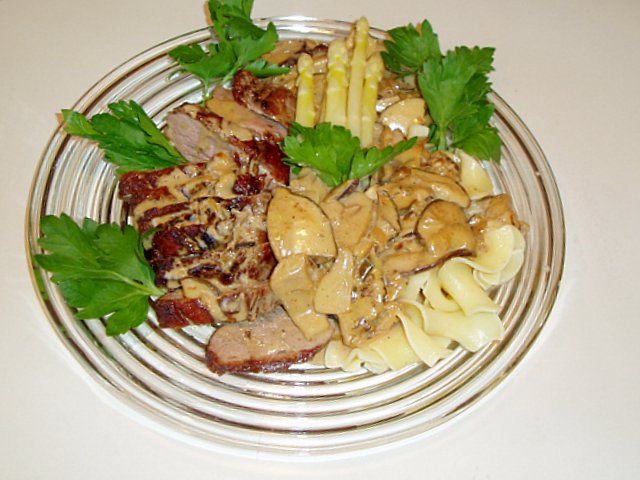
½ # oil poached Salmon
1C poached Asparagus cut on the diagonal
1 stalk chopped Celery (about ½ C)
¼ chopped Red Onion (about ½ C)
1/3C chopped Chives
1/3 C sautéed Walnuts
1/2t Canola Oil
Dressing
1/2C Light Mayonnaise
2T Extra Virgin Olive Oil
1T grated Horseradish
1t dried Dill
1t fresh Lemon Juice
1/2t Kosher Salt
Fresh Black Pepper to taste
Oil Poached Salmon-
½# Salmon
1C Olive Oil
2 cloves Garlic
1T chopped Onion
1 6” Rosemary branch
Juice of 1 Lemon
2 slices of Lemon
Cut salmon into 1” cubes and reserve.
Heat the oil to 160° and add the rest of the ingredients to a 1 quart saucepan with a tight fitting lid. Gently lower the salmon into the oil and cover. Cook for about 10 minutes or until “medium rare”. Turn off heat and let rest in the oil for 10 minutes. Remove salmon and drain on paper towels. Cover and chill. The poaching oil can be strained and kept in the refrigerator and used again.
Dressing-
In a small bowl add mayonnaise and olive oil. Whisk vigorously until the olive oil has become “absorbed” or emulsified into the mayonnaise. Add the rest of the ingredients and mix well.
Sauté walnuts in canola oil until fragrant and toasty brown. While still warm, sprinkle with a pinch of kosher salt and toss. Save for the garnish.
Combine the rest of the salad ingredients and gently mix with the dressing. Garnish with walnuts.
Garnish with walnuts.
This is an article that was e-mailed to me through the Association for the Study of Food and Society (ASFS) www.food-culture.org It's an interesting group with a different view of food and culture- I hope you enjoy this article and it gives you food for thought!
Queen Art-o-Eat
With All the Conflicting Headlines, No Wonder We Can't Decide What to Buy
By Candy Sagon
Wednesday,
I can't decide what to eat. I don't mean which recipe to make, or what restaurant to go to. I mean when I go grocery shopping, I'm paralyzed with indecision. Everything, it seems, is either ethically, nutritionally or environmentally incorrect. Guilt is ruining my appetite.
Take the other day when I went to buy eggs. Sounds easy, but this is the dialogue that played in my head as I stared at six shelves of egg cartons:
"Should I buy the omega-3 eggs that are supposedly good for my heart? But wait, they're not organic. Maybe I should spring for the $3.50 organic eggs from Horizon, even though I read that the company has gotten so huge, it's driving out the smaller organic farmers. Perhaps I should get the cage-free eggs from a small farm in
"Oh, never mind. I need to save money. So what if the hens are living a miserable existence in the poultry version of the state pen. The eggs are only 79 cents. I have bills to pay."
(Note to PETA: Don't worry. I couldn't live with the guilt. I ended up buying the brown eggs from free-roaming happy hens, so don't write to me.)
The point is, choosing what to eat and drink has become hard work. It's not simply a case of taste or price. Now we have to ask ourselves: Is this good for my health? Have animals suffered? Is it local? Organic? Bad for the planet? Harvested by child workers?
What's worse, the answers are often contradictory. Should I buy the locally grown lettuce at the farmers market, even if the farmer uses some pesticides? It's good to support local farmers, but what about pesticides' link to cancer? Then again, that California-grown organic lettuce at the supermarket has been trucked in thousands of miles, burning up thousands of gallons of fuel. Does that make environmental sense?
Even when you think you know the answers, it turns out you don't. Consider salmon. To prevent the over-fishing of wild salmon, which was also wildly expensive, farm-raised salmon was developed. It seemed the perfect solution to control
The tough decisions aren't limited to the fish counter. Books such as Eric Schlosser's "Fast Food Nation" (Houghton Mifflin, 2001) have raised questions about the humane treatment of cattle and of the immigrants working in packing plants. Critics wonder how closely the federal government really inspects the meat we eat. The feds say our meat supply is safe, but companies aren't required to announce recalls of contaminated beef. And what about that
Oh, wait. Avian flu. Salmonella. Chickens raised in factory farms. Manure runoff polluting the
I think I need to lie down.
My anxiety over what to eat is what Michael Pollan addresses in "The Omnivore's Dilemma" (Penguin Press, 2006). The question of what to have for dinner has become complicated, he acknowledges. Fast food and processed food are making us fat. Dietary advice is confusing. Even organic is becoming big business, including organic junk food and organic factory farms.
But refusing to consider these developments is not the answer. Ignorance, he argues, is not bliss. It's just ignorance. "To eat with a full consciousness of all that is at stake" can afford great satisfaction, Pollan writes, because it lets you choose what is best for you. Bottom line for him in the dinner dilemma: Choose local.
Still, I wondered if there might be some moral and ethical template I could apply to my food decisions. Arthur Caplan is the director of the Center for Bioethics at the
"Oh, absolutely. And it doesn't even end with the food," he says. "One of my great moral quandaries comes when the cashier asks, 'Paper or plastic?' " (For the record, he chooses paper.)
Caplan believes there's no need to have "a moral aneurysm" every time we go to the supermarket. Every person, he says, needs to establish a scale of ethical priorities. Is taste most important to you? Cost? The environment? Your health? Animal suffering? Pick one thing that matters most and let that drive your decisions.
For Caplan, No. 1 on his list is whether suffering was involved. "So I want happy chickens, no veal, no foie gras. After that comes environmental impact, and then labor. I have an ethical guide in my head that helps me through the store."
He also points out that, in a way, we should be grateful we are even considering all these ethical questions. "These are the dilemmas of abundance," he says. "If we were living in
Lobster Memories-
Summer and the 4th of July always flood my pea-brain with memories of lobsters. These days it's few and too far between when I can indulge in these pinching crustaceans. I live on another edge. The memories are always there to be relived and savored.
My introduction to lobster eating wasn’t in the summer but in the bleak late fall. My aunt and uncle had bought a home in
My aunt and uncle were excited about the trip to
Lobster Man was big and beefy,not huge. He wore a matching outfit of grey green pants and shirt. A belt fastened tightly below his belly kept the pants up and cigarettes and matches filled his shirt pockets. There were white socks and well worn work boots at the end of his bandy-legs.
A hug from Lobster Man was a sensory experience. First was my physical crush next to an unknown person. A large body that some would call a beer belly but that beer belly was far from flaccid. It had been hau
I looked around the room and saw a Sears stove. On top was a big aluminum pot with a battered lid. Steam was escaping from the boi
My aunt took control of the event and was quickly spinning stories of their recent tour of duty. Every once in awhile my uncle would interject a word or his own story into the conversation. I was left to watch and listen.
After awhile Lobster Man slipped outside and came back with a tub of lively lobsters. I had never seen them before and had only heard of them from my aunt and uncle. Lobster Man pushed the sea weed aside and I gazed at my dinner. Their dark shells moist from the sea glistened. They weren’t a uniform color but a greenish-black on top and orange below, the joints and claws had azure blue accents. The antennas were long sensuous appendages that lay straight along side the lobster ending at the tail.
Lobster Man picked up a specimen. It was mad and snapped its tail while the claw arms stretched out as if were flying. There were tiny hand-made wooden nails jammed in the claws to prevent them from pinching. One claw was larger than the other. I looked with amazement at this crustacean. Lobster Man showed me a trick. With his thick wrinkled thumb his slowly rubbed the lobster between its eyes. On the count of 10 the lobster lost its fight and by the count of 20 the lobster was limp in his grasp. Lobster Man winked and said we had relaxed it enough to be dropped in the pot.
I was given a turn at warming the lobster’s brain and we quickly filled the pot with lobsters. I was in for a shock for when they were done; they had turned a beautiful shade of reddish orange.
The table was covered in oil cloth and a healthy padding of newspaper. A small pot held melted butter. We were all given lobster crackers and little picks. I stared at the lobster on my plate and had no idea where to start. My aunt was expertly giving me directions but out of the corner of my eye I watched Lobster Man. Unlike tourists who ate the tail and claws then cast the shells away, Lobster Man started by breaking off the smallest walking legs. He then broke off the tiny “foot” and sucked the lobster nectar from the legs like they were flavored straws. I tried this and was soon flattening the soft leg with my teeth and extracting the smallest bits of meat.
Next Lobster Man broke the claws and laid them aside. He snapped the body and removed the tail. It was laid next to the claws. A pop off of the body shell showed the stomachs, brain, and other inedible bits. There was a white gelatinous film that was poached onto the underside of the shell; he ate that and I followed. Again it was just a sweet taste of the sea. After Lobster Man had exhausted all of the minor players in the feast, the claws and tail were eaten.
The claws took skill to crack without piercing the meat with the crushed shell. Just a pump of the cracker to apply enough pressure. There was a curious technique to extract the tail meat. By this time the lobster was warm. Lobster Man ripped off the tail fins as if he was bending back someone’s fingers; then he straightened the tail holding it in one had and pushed two of his fingers up the broken end. Quickly the whole tail meat emerged from the spot where the tail had been attached to the body. My lesson was complete. By this time we all were quietly dunking bits of lobster in butter and bringing the dripping pieces to our mouths.
I don’t remember if we were served other dishes at that meal. I’m sure there were no green vegetables but perhaps some soft rolls to soak up the butter. But really- when you eat lobster do you need anything else?
Queen Art-o-Eat
I have a secret (and soon to be exposed) fetish- I love the NYT (New York Times). It started over a summer in
I was sitting at my grandfather’s kitchen table. A non-descript faux colonial wooden table with barrel shaped chairs. In front of us billions of words and piles of papers were languishing. There was the sensational NY Daily,
I don’t know why I grabbed that paper- perhaps it was because no one else had claimed it. The front page had a center picture in black and white. I dropped the paper in my lap and removed the first section. As I opened the first page my eyes fell on the upper right corner and a Tiffany’s add for jewelry, this habit continues.
As I laboriously read the paper I realized its tone was removed and analytical lacking the!! points and sensationalism that other papers possessed. At the time I couldn’t perceive the political bent or slight liberal persuasion, I just found it refreshingly dry and “tailored” to my point of view.
Sitting at the table that summer Sunday with my grandfather, I felt we were exploring the news together. My grandfather, a slight man who was quite wealthy always dressed in a matching Sears khaki or green shirt and pant outfit. Brown belt resting high on his waist, brown tie-up shoes and always snow white socks. His top shirt pockets were full. The left one held a pocket protector filled with pens and pencils. The right held his soft pack of Camel cigarettes and non-descript matches.
On the table his ever lit Camel was resting to the left in an ashtray and a Stangl coffee cup and saucer held black coffee. Of course we never spoke that day in the kitchen and I have no clue what he read in the mounds of papers in front of him but it was a quiet time that sealed my affair with the NYT.
My affair grew in college. I would scrape up quarters to by certain editions that I couldn’t live without. Fox Butterfield “wrote” me articles about
Shortly after I met the NSSP (see second entry for term) he was wooing me with a future in
The paper wasn’t delivered to our door so a weekly trek to our little village and bookstore quickly became our family’s Sunday “church” amid the dedicated Christian Reform natives crowding the streets. At first it was hand-in-hand with NSSP. Later we walked with the Princess in her stroller as she randomly tested her vocabulary on each bump. Later we graduated to family bicycles and a goal of going from point A to point B without fal
We’ve had several opportunities to live in different places, but the first and foremost question was if the NYT could be delivered. There was a brief time when we lived in
Today I live on the edge and each day I crawl to the top our driveway to retrieve my blue bagged newspaper. Yes, I could get it online but I would be missing “my” Tiffany ad on the upper right.
I love the blue plastic bag. Each day it announces a new weekly section. Monday is the sport section (the only part I overlook) and a little Metro department where people contribute their NYC observations. Tuesday is the Science section and Jane Brody always discusses timely topics with me. Wednesday holds the food section, and the amazing restaurant reviews by Frank Bruni.Thursday is a busy day with a circuits section hidden in the business section, a house and garden section And a fashion and style section! So what could be better? The Friday escapes and the two arts sections; one for the movies and the other for the museum openings. I coast into the weekend with Saturday’s stripped down paper and a few human interest articles. Finally it’s Sunday and a world of news awaits me.
My kitchen table today, a black marble rectangle that rarely sees the light of day, resembles my grandfather’s table from long ago. Mounds of reading matter wait to be read through the now necessary reading glasses and my mug of coffee.
Read and Explore!
Queen Art-o-Eat